English ![]()

T: +86-13929953340
E: eric@fshope.com
E: eric@fshope.com
No.2-1, Beiyuan Central Road, ShishanTown, Nanhai District, Foshan City, Guangdong Province, China.
Views: 0 Author: Site Editor Publish Time: 2026-04-03 Origin: Site
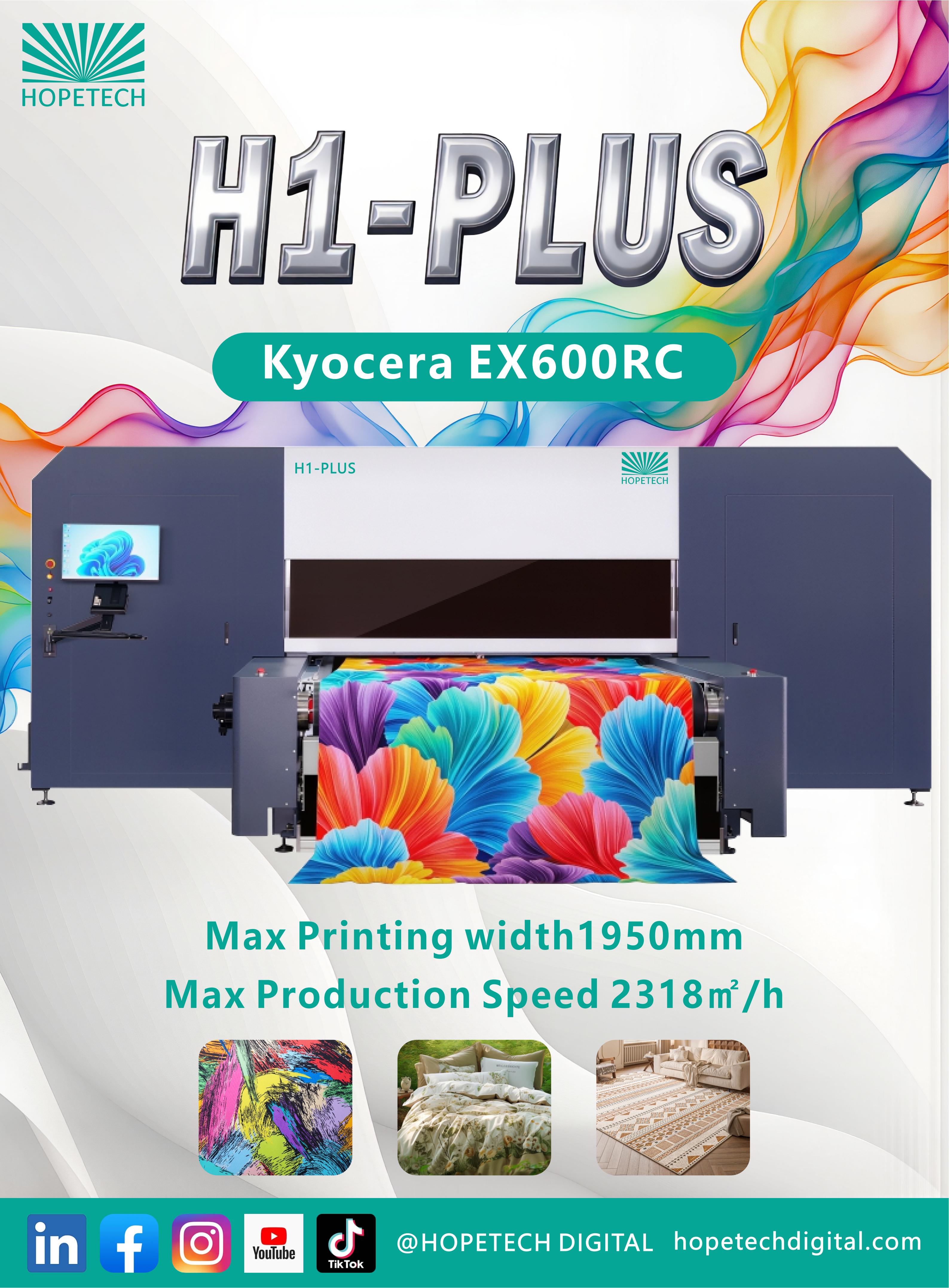
For textile manufacturers handling large-volume fabric processing, one core question stands out: Can a single machine simultaneously deliver stable production capacity, high efficiency, and consistent printing quality? The H1-PLUS-K64 is engineered specifically for such industrial fabric printing scenarios. Equipped with 64 industrial printheads (arranged in an 8×8 array with an 8-color configuration) and boasting a maximum printing width of 1950mm, it covers wide-format apparel fabrics and other garment-related applications—scenarios that demand strict production speed, where downtime incurs high costs, and consistent quality is non-negotiable during long-run production.
From a practical production standpoint, bulk fabric printing is about more than just running speed. What matters more is that the equipment ensures smooth ink supply, stable fabric feeding, consistent image output, and easy maintenance during continuous operation. This is the key advantage that industrial-grade digital fabric printers hold over entry-level models.
The H1-PLUS-K64 is an industrial-grade digital fabric inkjet printer tailored for the textile printing industry. It is purpose-built for industrial manufacturing, not general desktop printing—a distinction that matters greatly, as industrial users seek far more than just graphic output. They require a machine that supports:
Continuous fabric production
Large-scale order processing
Stable inkjet performance
Seamless integration with industrial workflows
Long-term repeatable printing quality
Compatible with reactive, disperse, acid, and pigment inks, it adapts to a full range of textile fabrics, including cotton, linen, silk, wool, polyester, nylon, and blended fabrics. As such, the H1-PLUS-K64 is ideally suited for efficient bulk apparel fabric printing.
Not all textile manufacturers have the same production needs. High-speed industrial equipment is best suited for enterprises with consistent daily output requirements and order volumes that justify industrial-scale capacity. The H1-PLUS-K64 excels in the following production scenarios:
Apparel suppliers often need rapid turnaround of printed fabrics for fashion collections, private-label production, and seasonal fast orders. In these cases, production efficiency directly impacts delivery speed and overall profit margins.
The H1-PLUS-K64 offers dual printing modes: high-definition and high-speed. It delivers up to 2318㎡/h in single-pass high-speed mode, 1280㎡/h at 2Pass, and 708㎡/h at 4Pass—allowing flexible switching based on order requirements to balance capacity and quality.
For apparel fabric production, buyers prioritize:
Reliable long-run continuous production
Consistent color and pattern across batches
Minimal downtime during production changeovers
Contract printing factories serve multiple clients with diverse order types, focusing primarily on garment fabric printing. This places high demands on scheduling, fabric handling, and machine utilization—and high-speed textile inkjet printers like the H1-PLUS-K64 significantly boost overall production line efficiency.
When buyers search for terms like "bulk fabric printing machine", "industrial textile inkjet printer", and "high-speed fabric printing equipment", they are essentially comparing the real production value of different machines—with final decisions based on practical utility. The core considerations are as follows:
Impressive specifications on paper mean little; actual production capacity depends on stability in real-world operation. Backed by the reliable performance of 64 industrial printheads and a mature hydraulic ink supply system, the H1-PLUS-K64 ensures stable output during long hours of continuous operation.
Production teams should evaluate the H1-PLUS-K64’s performance during extended production runs, not just under ideal demo conditions. Key points include: stable output during long shifts, a smooth fabric transport system, an operator-friendly workflow for high-volume jobs, and minimal production interruptions due to maintenance. High-quality bulk printing equipment reduces unnecessary downtime—even brief stops can quickly lower effective daily output.
In industrial textile printing, the machine must integrate seamlessly into a complete production chain, including fabric pre-treatment, printing, drying and fixation, quality inspection, and winding. Instability at any stage will slow down the entire line.
Professional buyers evaluate full workflow compatibility: fabric adaptability, ink system compatibility, feeding and winding control, integration with upstream and downstream finishing processes, and ease of operator training and production management.
The H1-PLUS-K64 adopts a three-phase 380VAC, 30kW industrial power supply, with main unit dimensions of 5710×4975×2275mm and a total weight of 9500kg. It complies with industrial workshop layout standards and connects seamlessly to existing production processes, making it ideal for buyers focused on overall workflow efficiency rather than just the machine itself.
Almost any machine can produce attractive results in small-batch sampling, but consistency is the core challenge in bulk printing. Production teams must ensure acceptable color alignment, pattern clarity, and visual uniformity from the first to the last meter of fabric.
This is particularly critical for fashion fabrics requiring repeatability and contract garment jobs where reprints eat into profits.
Fast machines that are difficult to maintain lead to high long-term operating costs. Buyers should closely examine daily cleaning requirements, operational convenience, parts replacement ease, and after-sales support.
In real factories, maintenance convenience often impacts output more than rated speed. Easy-to-maintain equipment better ensures uptime and printing consistency.
When orders surge in a short period, slow equipment creates scheduling pressure. The H1-PLUS-K64’s maximum capacity of 2318㎡/h in high-speed mode efficiently handles peak demand—especially for production lines already equipped for bulk garment fabric manufacturing.
Some businesses start with small-batch equipment and later need an industrial model as orders grow. The H1-PLUS-K64 helps them scale capacity and optimize production planning.
If production losses stem from unstable operation and repeated corrections, the best choice is not the fastest machine, but one with more controllable long-run performance. For most factories, stability and maintainability directly affect the cost per meter of fabric.
High-speed industrial equipment is not suitable for every buyer. Avoid the following risks:
If your business mainly handles small custom orders or sampling, large industrial equipment is not an efficient investment. Capacity must match actual demand.
Textile digital inkjet production relies on more than just the machine. Inks, fabric pre-treatment, finishing processes, and operator discipline all impact the final result. Without complete workflow support, the machine cannot deliver expected returns.
Efficient operation of industrial equipment depends on technical support, spare parts inventory, and operator training. Buyers must confirm these aspects before purchasing critical production machinery.
Low-capacity equipment is more suitable for: fabric sampling, small-batch customization, frequent design changes with low daily output, and scenarios with limited space and staffing.
In contrast, the H1-PLUS-K64 focuses on efficient bulk fabric printing. Backed by 64 Kyocera printheads, a 1950mm width, and a maximum capacity of 2318㎡/h, it prioritizes production capacity, continuity, and compatibility with industrial workflows.
The H1-PLUS-K64 is a high-speed industrial digital textile inkjet printer built for large-scale fabric printing factories. Its core value lies in supporting stable long-run production, convenient maintenance, and seamless integration into the full industrial fabric printing workflow.
For buyers comparing textile inkjet solutions, the most practical approach is to evaluate the machine against real production conditions: order volume, fabric types, finishing processes, operator capabilities, and downtime tolerance. This type of evaluation leads to better decisions than focusing solely on claimed speed.
If your goal is to improve large-scale textile production capacity, the H1-PLUS-K64 deserves consideration. The next step is to determine whether its industrial positioning matches your actual production needs.